top of page
Ocean Water

JOIN the team!

Read about the roles below!

As a member of a technical student orgnaization at NTNU, you will find yourself at the center of a highly motivated group of students, as well as at the most visible edge of the student body.


While you will get many opportunities to connect with companies and potential employers, you will also have a place to meet other like-minded people, and a place to lower your sholders close to campus.

IMG_0298.jpg
IMG_6402_edited.jpg

In a position at Vortex NTNU, you will contribute to our endeavour to become the leading national student organization on all things maritime robotics.


Currently, we are developing an untethered Autonomous Underwater Vehicle, as well as an Autonomous Surface Vehicle.


A big goal is to unify the AUV with the ASV such that they communicate. This is up to date with what the maritime industry is researching and developing the recent years.

Software Leadership

The Embedded Systems lead in Vortex NTNU guides the development of onboard electronics and embedded software, ensuring hardware and software work well together. The role includes supporting team members, organizing tasks, and maintaining good engineering practices. This position helps the team deliver reliable and effective embedded systems.The

Control lead has agency over the control systems that govern the motion of the drone, and it is the control leads job to ensure predictable, stable and safe manoeuvring of the drone. The control team also utilizes the simulator to a large degree and needs to maintain an accurate kinematic model of the drone for both simulation and testing. Lastly the control lead is also an administrative position which needs to prepare tasks and goals, keep track of the group members' progress and set deadlines.


The Autonomous Systems lead is responsible for the autonomous behaviour and mission planning of the drone. The autonomous system lead plans in collaboration with the other software teams, the execution of missions, and how it is to be implemented. They are responsible for implementing and maintaining the drone’s decision-making logic, including the mission state machine that governs autonomous actions and transitions between behaviours.


The Perception team lead is responsible for the systems that enable the drone to understand its environment using onboard sensors and data processing. The role involves developing and maintaining perception pipelines (e.g., detection, tracking, localization, and mapping as needed), ensuring robust performance in real-world conditions. The perception lead also supports team members, organizes tasks and milestones, maintains good engineering practices (testing, documentation, code reviews), and helps validate performance through simulation and field testing.

The GUI team lead is responsible for designing and developing the user interface tools that operators and developers use to monitor, control, and debug the drone and its systems. The GUI lead coordinates closely with the autonomy, control, and embedded/software teams to define stable data interfaces and ensure the GUI reflects the real state of the system. They also support team members, organize tasks and milestones, and ensure the GUI is usable during live operations.

Hardware Leadership

The Electronics team lead is responsible for the technical development of the electrical systems of the drone. This involves coordinating the work between the Electronics team and the rest of the organization, while also overseeing the electronics design process.


The Mechanical team lead is responsible for guiding the team through various design processes relating to the physical design of the drone and its modules. The team is responsible for ensuring that the drone meets requirements relating to both competitions and underwater operations and has a major impact on the success of the project.

Board

The Project Manager is responsible for the overall vision and progress of the team throughout the year. They are also the leader of the Board and works closely with all leaders to ensure that the organization keeps improving year on year. The Project Manager is also the main representative of the organization to sponsors, NTNU, other organizations, and to the public.


The Deputy Project Manager works closely with the Project Manager in their duties, while also focusing on the well-being of the organization on a day-to-day basis. This involves managing both internal and external events. The Deputy Project Manager also manages sponsor relations, and the practical tasks relating to this.


The Head of Business and Accounting has the primary responsibility of maintaining the organizations finances and accounting. They work closely with the Project Manager and the Deputy Project Manager to ensure that the organization’s short- and long-term goals are met, while also supporting the Board and leaders with purchasing and budgeting.


The Head of Operations is the leader for the Administration and Logistics team. This is a critical support function to ensure that the design cycle of the project is carried out, while also ensuring that knowledge and experience is retained between teams. The Head of Operations is also responsible for planning, testing, expeditions, and participation in competitions.


The Head of Marketing is the leader for the Marketing team. This includes conveying the work we do to the public in addition to carrying out promotions related to sponsorships. The Marketing team decides the visual profile of Vortex NTNU and designs the merchandise we use.


The Chief Technology Officer Software (CTO Software) has the overall responsibility of software development and architecture of the project. They work closely with CTO Hardware to determine requirements for the vehicles, while also supporting the various software leaders in their work. CTO Software is also responsible for DevOps.


The Chief Technology Officer Hardware (CTO Hardware) is responsible for the physical design of the vehicles and works closely with CTO Software to ensure that requirements are realistic and sensible. They support and guide the hardware leaders in the work they do, while also assisting with purchasing and ordering. CTO Hardware is also responsible for workshop facilities and for HSE in the organization.

Support

The Web Lead is responsible for the development, maintenance, and long-term vision of Vortex NTNU’s website. The role involves leading the Web Development team and overseeing the transition from Wix to a fully self-developed solution using React and TypeScript for the frontend and PocketBase for the backend. The Web Lead ensures the website runs reliably, remains up to date, and reflects the organization’s activities and identity, working closely with other team leads to keep content accurate and aligned with ongoing work.

Check out all the teams

Marketing

CREATIVE

As part of the marketing team you are responsible for everything related to how Vortex appears externally. A critical part of our operation is reliant on good external relations, sponsors relations, and outreach. 


The marketing group has a lot of freedom to market how they want, and we are excited to invite bold and creative individuals to apply, so that we can take our profile to new levels.

Spons type beat.jpg
Mechanical

HARDWARE

Every physical structure in our drones is the result of the excellent work by our mechanical team! If you are hands-on and wish to contribute to our drones in a very physical way this might be for you.

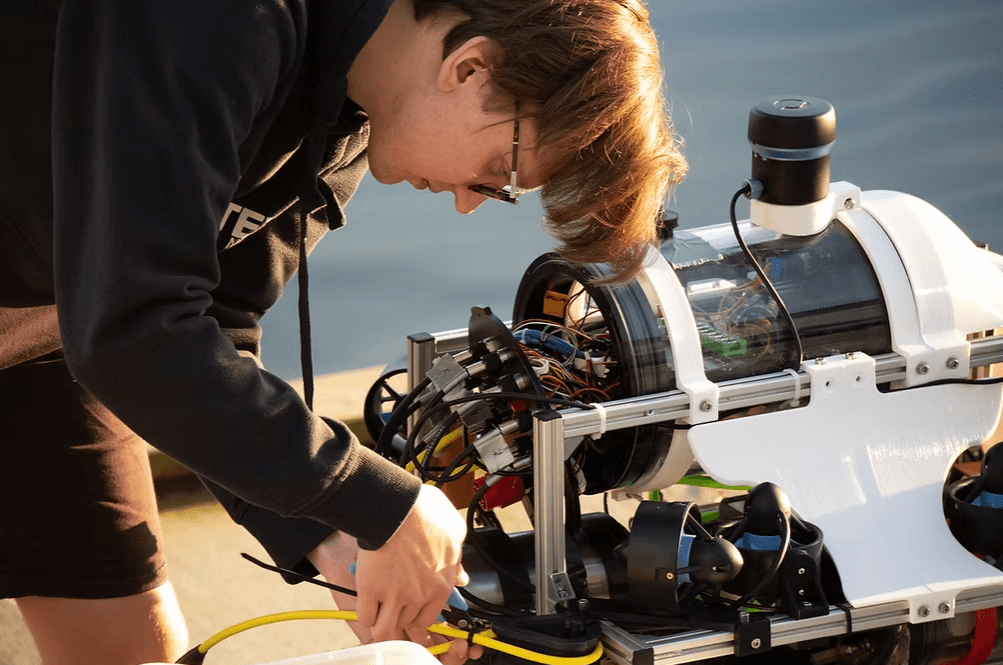
As a member of the mechanical team you will be responsible for all physical structures in our drones. This includes the entire process from concept design to prototyping and assembly of the final product. 

DSC05741_edited_edited.jpg
Electronics

HARDWARE

The electronics group is responsible the power distribution, wiring and communication buses in our drones. And waterproofing of course! As part of the electronics team you will either design PCBs, utilize waterproof connections to enable power distribution and communication across different modules, and be responsible for embedded systems design.


In addition, you will learn how to solder and be responsible for putting together PCBs once they have been designed.


D9649067-FB61-4439-A53C-5EDE4E92CA76.jpg
embedded_work.jpg
Software

THE BRAINS OF THE OPERATION

The Vortex software stack is the result of many years of software development, and we are looking for new members eager to contribute to this!

As a software member, you will have many paths to choose from, all with a variety of tasks. This includes control systems design, SLAM, computer vision and object detection, embedded software design, and underwater acoustic communication.

You will learn how to use the Robot Operating System with Python and C++ to develop code for a highly advanced and robust platform, and how to test, deploy and verify your code as part of a software team!

|

Electronics
Mechanical
Embedded Systems
Autonomous Systems

The Autonomous Systems team is responsible for designing and implementing the guidance and navigation stack of our maritime drones. You will learn how to fuse sensors such as GNSS, UGPS, DVL, and IMU to get reliable position and orientation estimates of a robot.


In addition, the team is tasked with developing various mission planning schemes to complete tasks in a robust manner during our various competitions. Being a part of Autonomous Systems will get you to work closely with advanced estimation- and control theory to enhance localization and maneuvering of the drones. 

IMG_1801.jpg
look_at_this_dcfa.jpeg
Situational Awareness

The members of Situational Awareness are responsible for how well the drones perceive their surroundings. Our drones are mounted with various sensors to detect obstacles, points of interest, and competition objectives in the environment. As a member of Perception, you will have the chance to work with sonars, lidars, and stereo cameras, and use various algorithms on the sensor data.


The drones utilize image & pointcloud processing, machine learning, and statistical analysis to perform object detection and tracking both above- and underwater. Becoming a part of perception will allow you to push these sensors to their limits and comprehending when they are trustworthy. 

DevOps

The DevOps team collaborates closely with the other software teams, with each member specializing in support for a specific team. Their primary role is to improve efficiency through continuous integration and the development of automated tests for the drone.


You will function as a regular member in the team you are specializing in, enabling you to understand their systems better and contribute more effectively. You will also have the opportunity to work on projects where we use DevOps technologies, such as infrastructure as code and Docker.

screenmaster1.jpeg
Peception
bottom of page